

Policy Response Mechanism (PRM)
A fundamental aim of the project is to facilitate the exchange of knowledge among scientists, policymakers, as well as business and civil society actors, in the EU, targeted major emitters, and non-high-income countries around the globe. A dynamic mechanism is needed to structure this exchange most effectively via co-creative stakeholder engagement.
We designed a novel stakeholder engagement process, the Policy Response Mechanism (PRM), with the aim to structure a co-creation process that facilitates knowledge sharing and collaboration between modelling teams and stakeholders as well as dynamically respond to changing policy priorities. Key PRM objectives include ensuring policy relevance, exchanging knowledge, bridging the gap between the formalised modelling frameworks and the real-world context in which decisions are made, and enhancing trust between modellers and stakeholders, by providing different layers of inputs and making modelling socially and politically realistic. Each PRM policy cycle comprises the following steps:
1. Modellers | Identifying overarching policy themes and inviting relevant policymakers to form policy steering groups (3-5 high-level policy stakeholders each).
2. Modellers & policy steering groups | Substantively communicating the typical capabilities of IAMs and co-creating policy questions under the policy themes.
3. Modellers | Transforming policy questions into research studies, grouping them into research themes, and inviting relevant stakeholders to form core working groups (10-20 technical policy, industry, and civil society stakeholders).
4. Modellers & core working groups | Refining studies, mapping questions onto IAMs, and co-designing scenarios within each research theme workshop.
5. Modellers | Carrying out a first iteration of multi-model exercises per study.
6. Modellers & core working groups | Disseminating and elaborating on the results of, and eliciting feedback on, the first modelling iteration per study, within each research theme workshop.
7. Modellers | Carrying out a second iteration of revised multi-model exercises per study, based on the feedback of core working groups.
8. Modellers & core working groups | Disseminating and elaborating on the results of the second modelling iteration per research theme (via targeted slide decks shared online).
9. Modellers & policy steering groups | Disseminating and elaborating on the results of the entire IAM process and working together with the policymakers to co-produce targeted briefs per policy theme.
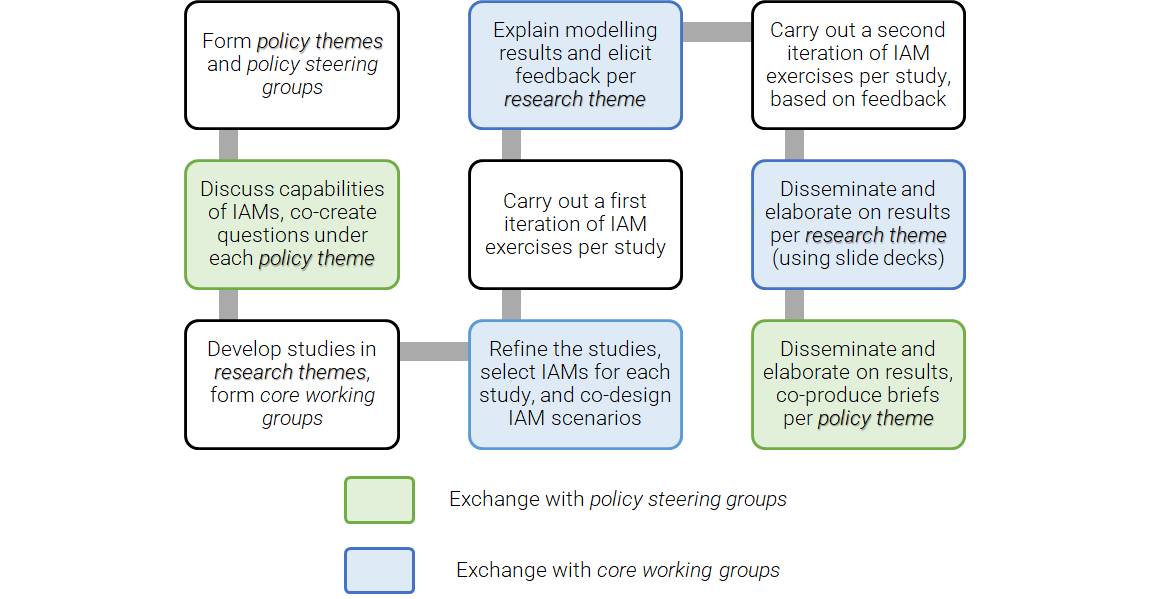
In advance of the first modelling iteration, modelling teams meet with the policy steering groups (one policy steering group per policy theme) to scope an initial set of policy-relevant questions. These are elicited through semi-structured interviews seeking to understand the climate policy priorities and explore what questions IAMs may be suitable to answer. This initial set of questions are then transformed into individual modelling studies, grouped within research themes.
The next step is done in collaboration with stakeholders in the core working groups, within workshops, where the outlines of the studies are presented. Through structured breakout rooms, studies are refined and scenarios co-designed with the stakeholders to ensure their policy relevance and acceptability of their assumptions.
After the first modelling iteration, results are presented to the core working groups for feedback, based on which another modelling iteration takes place with adjusted assumptions and/or scenarios. The final step is to return to the policy steering groups with the end results. Feedback is sought on the relevance of the policy insights emerging from the modelling process, with stakeholder views used to shape the publication and eventual co-production of outputs based on the studies.