
Second PRM
The conclusion of the first cycle overlapped directly with the start of the second cycle, through another round of meetings with the Policy Steering Groups (PSGs) during June and July of 2024. The policy-relevant research questions for the second cycle that emerged from those discussions with the policy-steering groups are detailed in the sections below.
At the meetings, project partners presented the high-level results from the first cycle studies to inform stakeholders about the work delivered in the project up to that point. Stakeholders were then asked how relevant the first cycle studies are for their work, if they had any suggestions for improvements, and if they saw any ongoing policy discussions, against which the study results could be appropriately framed. Moreover, stakeholders were requested to suggest any further developments of the first cycle studies, if they thought such contributions would be relevant.
More broadly, the policymakers were asked what research questions not already discussed IAM COMPACT could explore in the second cycle, especially considering the new context of EU policy priorities—i.e., what is relevant from the perspective of the newly elected European Commission. Through this approach, the PSGs provided feedback on the first cycle research, proposed some refinements and developments for the second cycle, and offered new policy-relevant research questions.
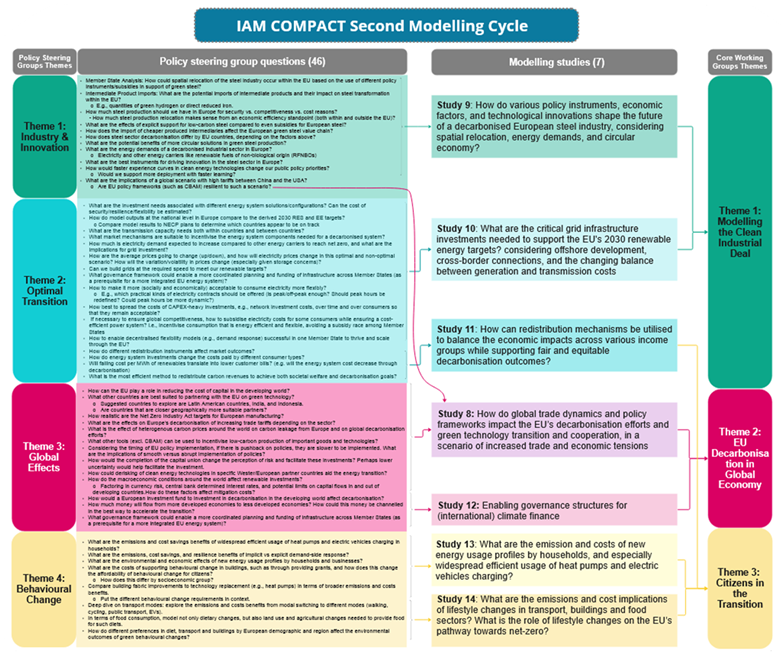
Our project team received 46 research questions from the PSGs, which were then grouped into seven new modelling studies. After internal discussion among modelling teams, an initial scenario design for each study was agreed and then presented to our Core Working Groups (CWGs) for discussion and co-design in three separate workshops.
- Study 8: How do global trade dynamics and policy frameworks impact the EU’s decarbonisation efforts and green technology transition and cooperation, in a scenario of increased trade and economic tensions?
- Study 9: Decarbonising the steel industry: how do policies shape the pathway to a decarbonised European steel industry, affecting energy demand, CO2 emissions, and the industry's geographic shifts within the EU and globally?
- Study 10: Updated NECPs and cost-optimal pathways: how do the updated NECPs compare to a cost-optimal path for reaching EU climate targets, considering grid infrastructure, offshore development, cross-border connections, and generation-transmission cost balance?
- Study 11: How can redistribution mechanisms be utilised to balance the economic impacts across various income groups while supporting fair and equitable decarbonisation outcomes?
- Study 12: Enabling governance structures for international climate finance
- Study 13: What are the emission and costs of new energy usage profiles by households, and especially widespread efficient usage of heat pumps and electric vehicles charging?
- Study 14: What are the emissions and cost implications of lifestyle changes in transport, buildings and food sectors? What is the role of lifestyle changes on the EU’s pathway towards net-zero?
These proposals were in turn grouped into three overreaching themes, “Modelling the Clean Industrial Deal”, “EU Decarbonisation in the global economy", and “Citizens in the Transition” and discussed with the Core Working Groups. In the final of months of the project we will be working to finalise the studies and present modelling results in the form of academic publications as well as policy briefs.