
Core Working Group workshop: “Citizens in the transition"
The workshop focused on lifestyle changes in mobility, diets, and housing, household decarbonisation, and distributional impacts of climate policies. Workshop outcomes will guide our use of Integrated Assessment Models (IAMs) to provide actionable policy insights.
The workshop brought together policymakers, civil society, and industry representatives to collaborate on policy-driven modelling. Your contributions will help shape our research outcomes, which centre on three key modelling studies co-developed with policymakers:
- Study 11: How can redistribution mechanisms be utilised to balance the economic impacts across various income groups while supporting fair and equitable decarbonisation outcomes? The study is led by BC3.
- Study 13: What are the emission and costs of new energy usage profiles by households, and especially widespread efficient usage of heat pumps and electric vehicles charging? The study is led by UPRC.
- Study 14: What are the emissions and cost implications of lifestyle changes in transport, buildings and food sectors? What is the role of lifestyle changes on the EU’s pathway towards net-zero? The study is led by UVa.
At the start of the workshop, a brief introduction of IAM COMPACT as well as the aims of the workshop were discussed by Bruegel. Then, study leads briefly presented the background and approach of both studies, before splitting into three break-out rooms.
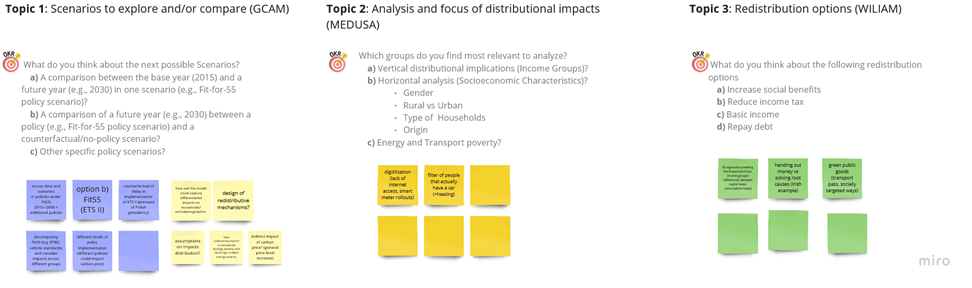
Room 1: Distributional Impacts
Topics for discussion:
- Scenario design
- Distributional impacts focus
- Redistribution options
Key takeaways:
- decomposing Fit-for-55 (EPBD, vehicle standards) considering impact across different groups
- counterfactual delay of implementation of ETS II
- indirect impact of carbon price
- considering digitalisation (e.g., lack of internet for smart metering)
- green public goods
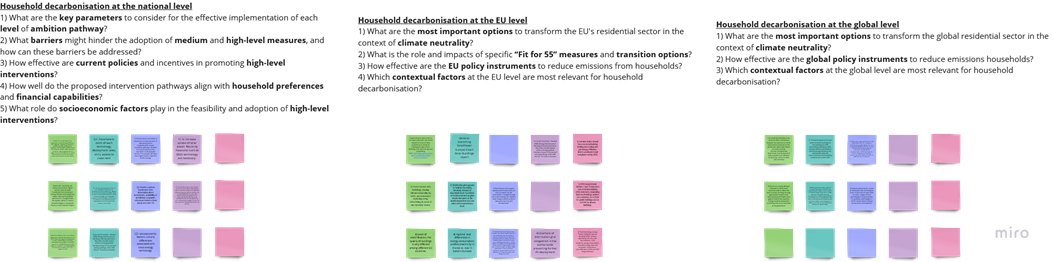
Room 2: Household decarbonisation
Topics for discussion:
- National level: barriers hindering adoption; alignment of policies with household preferences & financial capabilities
- EU-level: key options for residential decarbonisation; Fit-for-55 impacts
- Global level: most important policies for household decarbonisation towards climate neutrality
Room 3: Lifestyle changes
Topics for discussion:
- ranking lifestyle changes according to interest
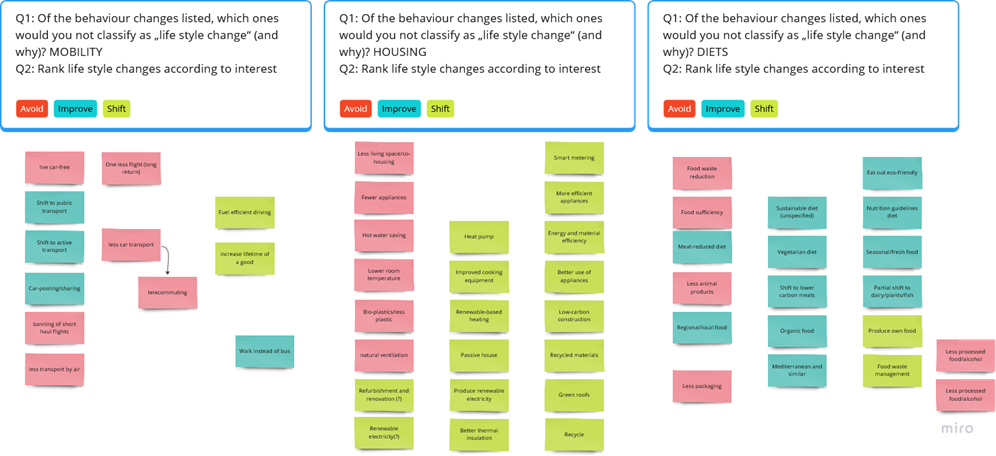
Key takeaways on Studies 13 & 14:
- Importance of understanding the effects of new energy consumption patterns on the broader energy system. For example, role of Interest on system cost and emissions.
- Two-part tariffs to incentivise flexible consumption while protecting consumers. Modelling of flexible vs. inelastic consumption in households.
- Importance of framing the modelling results in the context of the target. Realism (or lack of it) should be recognised in any policy document
- Improve the representation of the socioeconomic dimension and cost of implementing measures. For example, through subsidies for renovating housing or walking in transport.
- Stakeholders suggested implementing different degrees of lifestyle change in modelling to account for such realism.
- Stakeholders expressed an interest in refining the modelling from a demographic (different ages and income group) and regional perspective.
- Different energy profiles of households, again by demographic and region.
- The realism of the results should be explicitly stated, as well as whether it is incumbent upon the individual (i-frame) or on society (s-frame) to drive the changes.