
Core Working Group workshop: “Modelling the Clean Industrial Deal”
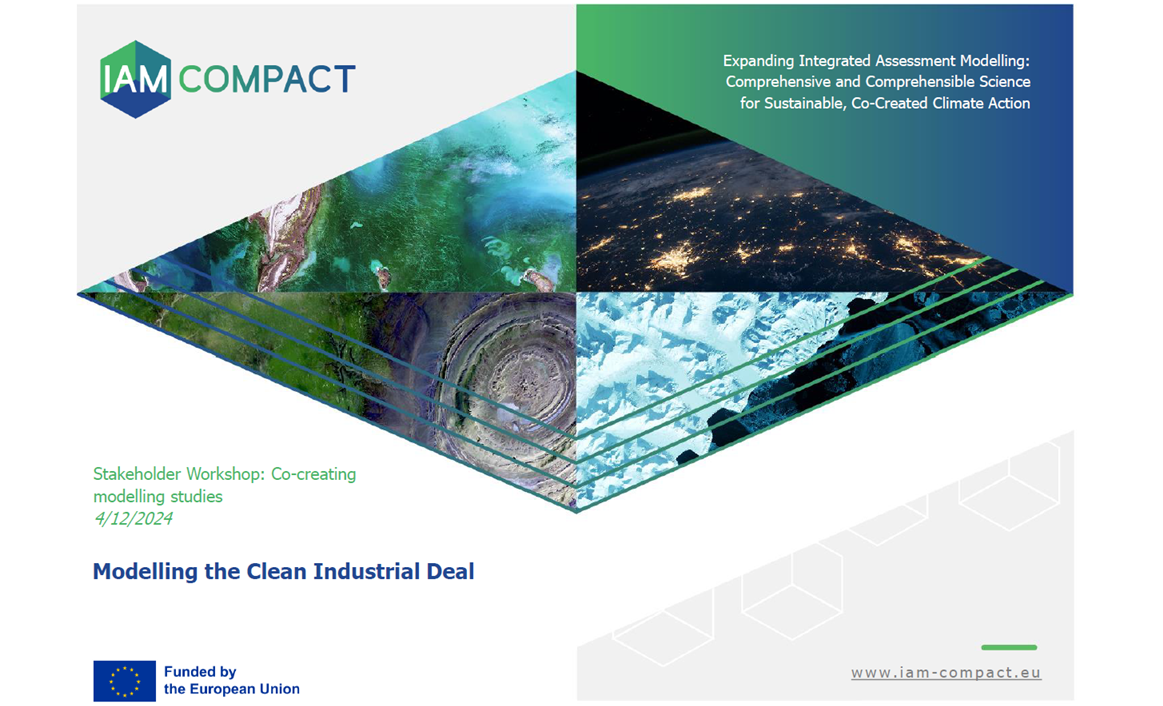
The workshop focused on the infrastructure investments needed to enable a clean economy, with a particular emphasis on decarbonising the steel sector. Workshop outcomes will guide our use of Integrated Assessment Models (IAMs) to provide actionable policy insights.
The workshop brought together policymakers, civil society, and industry representatives to collaborate on policy-driven modelling. Their contributions will help shape our research outcomes, which centre on two key modelling studies co-developed with policymakers:
- Updated NECPs and Cost-Optimal Pathways: How do the updated NECPs compare to a cost-optimal path for reaching EU climate targets, considering grid infrastructure, offshore development, cross-border connections, and generation-transmission cost balance? The study is led by NTUA.
- Decarbonising the Steel Industry: How do policies shape the pathway to a decarbonised European steel industry, affecting energy demand, CO2 emissions, and the industry's geographic shifts within the EU and globally? The study is led by WI.
At the start of the workshop, a brief introduction of IAM COMPACT as well as the aims of the workshop were discussed by Bruegel. Then, study leads briefly presented the background and approach of both studies, before splitting into two break-out rooms.
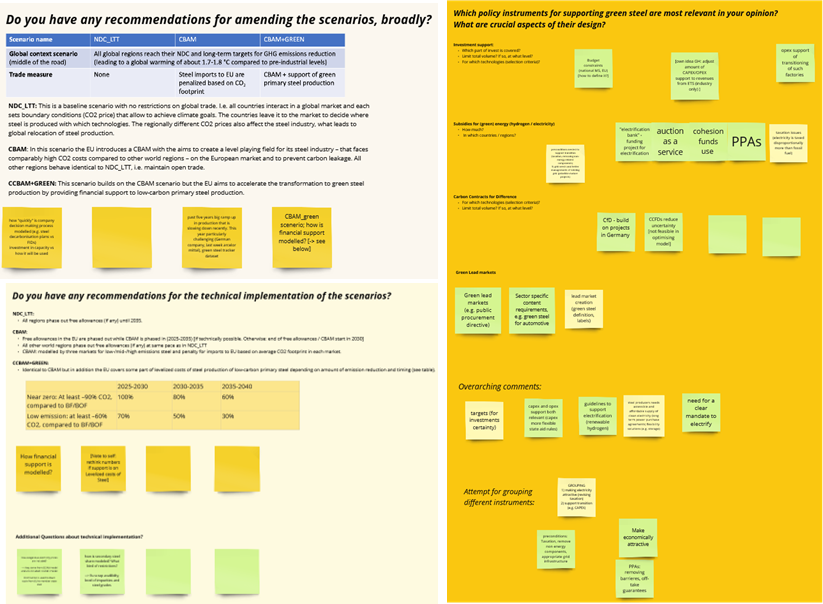
Room 1: EU Industry
Topics for discussion:
- Scenario design & technical implementation
- Policy instruments for supporting green steel
Key takeaways:
Scenario design
- Modelling of secondary steel
- CBAM_green scenario
Policy instruments
- Investment support
- Subsidies for green hydrogen / electricity; electrification bank; auctions as service; use of cohesion funds; PPAs
- Carbon contracts for difference; CCfDs reduce uncertainty
- Green lead markers; sector specific content requirements e.g., green steel for automotive
- CAPEX/OPEX support
Room 2: EU Infrastructure
Topics for discussion:
- What indicators are of most interest to you to illustrate the expected impacts of a decarbonised EU electricity system?
- How can modelling better reflect the role of power system transformation as a key factor of EU competitiveness and resilience (e.g., metrics)?
- What are critical uncertainties in achieving NECP/FF55 and net zero targets that should be addressed in our discussion/policy prescriptions?
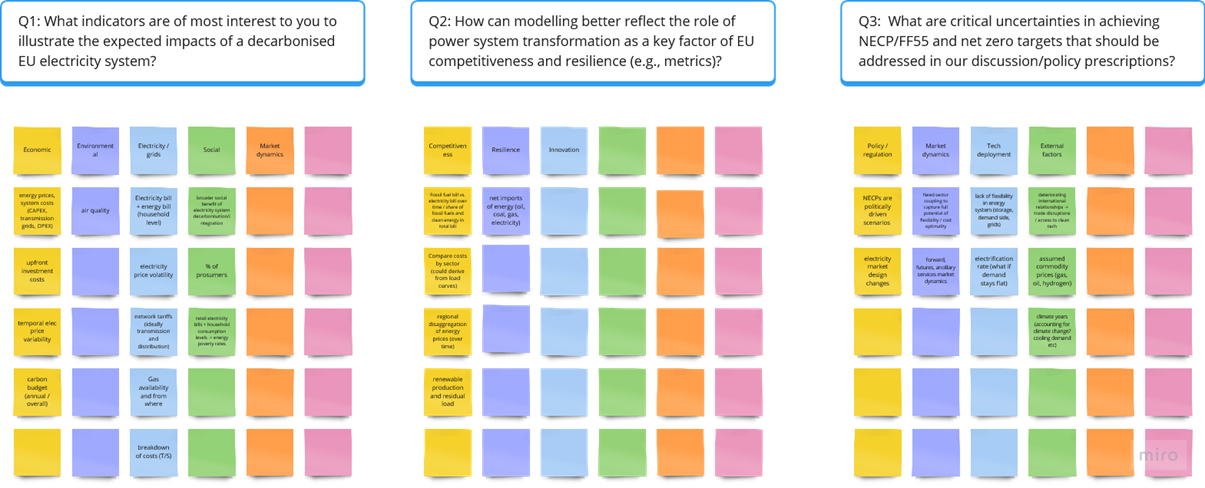
Key takeaways:
Indicators
- Economic: energy prices, system costs, upfront investment needs, carbon budget (annual / overall)
- Environmental: air quality
- Electricity / grids: electricity/energy bills for households, temporal electricity price volatility, network tariffs, natural gas availability and origin, breakdown of costs for transmission and storage
- Social: benefits of electricity system decarbonisation & integration, % of prosumers, energy poverty rates through electricity prices & household consumption levels
Modelling of competitiveness / resilience
- Competitiveness: share of fossil fuels VS clean energy in total electricity bills; comparing costs by sector, regional disaggregation of energy prices over time; share of RES production & residual load
- Resilience: net imports of energy
Uncertainties
- Policy/regulation: NECPs are politically driven scenarios; frequent changes of electricity market design
- Market dynamics: sector coupling to fully capture the potential of flexibility & cost optimality, development of ancillary services for power market size
- Tech deployment: electrification rate (what if demand stays flat), lack of flexibility in the energy system
- External factors: deteriorating international relationships, trade disruptions and access to clean tech, assumed commodity prices (hydrogen, FF) accounting for climate change (e.g., change of cooling demand).